Under the Roads (Scotland) Act 1984, permission requires to be obtained from the local Roads Authority before a footway crossing (dropped kerb) can be installed. A footway crossing is formed by lowering the kerbs to allow residents to drive a vehicle across the footway to gain access between their property and the public road.
To apply for a footway crossing, the following conditions must be met:
- The proposed off-street parking area within your property boundary must be of sufficient size to ensure that no part of a parked vehicle overhangs the public footway or road. Otherwise you could be liable to receive an Enforcement Notice issued by a Parking Attendant under the Transport (Scotland) Act 2019 provisions regarding pavement parking legislation.
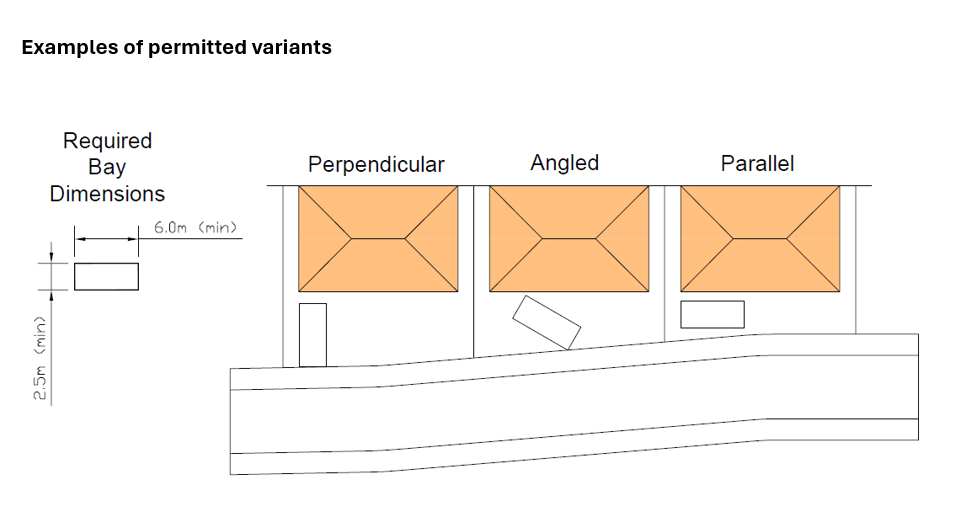
- Typically, this requires a minimum parking space length of 6.0m (or minimum 5.5m) measured from the back of the footway/property boundary to the front of your house or garage.
- A relaxation of the minimum length requirement may be considered if the applicant can provide scaled plans and evidence, demonstrating that vehicles parked at an angle (perpendicular, angled, or parallel as shown in the examples below) can be fully contained within the property boundary and not overhang the public highway.
- This flexibility is subject to a case-by-case assessment and depends on the specific road characteristics such as traffic volumes and ensuring safe manoeuvring in and out of the space without obstructing the carriageway or compromising public safety.
- This relaxation only apply to existing residential properties. Any new residential development must still fully comply with the standards set out in the SCOTS National Roads Development Guide (NRDG), as adopted by the local Roads Authority.
- Car parks or parking courts (existing or proposed) are also excluded from this relaxation and must adhere to full design standards.
- The proposed location for the access must be at least 10 metres from a road junction to maintain visibility and safety for all road users.
- The position of the access should ideally be altered to avoid obstacles such as street furniture (lighting columns, signs, utility covers) or trees. If avoiding the obstacle is not feasible, the local Roads Authority will determine whether the item should or can be removed or relocated.
- In the interests of road safety, drivers must be able to exit off-street parking places in a forward gear i.e. they must not reverse onto the public road.
- Applicants with charging facilities for Electric Vehicles are reminded of the requirements of the IET Wiring Regulations (BS7671) in regard to separation from metalwork connected to PME systems in that domestic EV charging equipment and charging EV vehicles should be min 2.5m away from any electrically supplied street furniture.
- The applicant is responsible for the full cost of all necessary work (by the local Roads Authority or an approved third party) to complete the dropped kerb and associated street furniture adjustments.
- Generally, if there is already an existing vehicular access that serves the property adequately, a second access crossing may not be permitted.
- If the proposed footway crossing is on an A Class, B Class or C Class numbered road, the applicant will first obtain planning permission from East Ayrshire Council or South Ayrshire Council as the Planning Authority under the terms of the Town and Country Planning (Scotland) Act 1997
Apply
On receipt of an application for a footway crossing we will carry out an assessment on site to ensure that the proposed location is suitable in both road safety and construction terms.
Once approved, you can arrange for a private civil engineering contractor subject to approval by the council, who will complete the appropriate Road Opening Permit.
To apply for permission, please complete the footway crossing (dropped kerb) application. An acknowledgement will be sent to you.
Contact Information